
The scent of freshly sheared cedar hits you first; it is a sharp, resinous tang that signals your brain to shift into high gear. You run your thumb along the edge of a raw walnut plank, feeling the open pores and the subtle resistance of the grain. This is where we begin. Nurturing Maker Mindset starts with the physical realization that you are the primary catalyst for transformation in the studio. It is not just about the "vibes" of crafting; it is about the literal friction between your hands and the medium. When you approach a project with a steady pulse and a sharp eye, you are engaging in a feedback loop of tactile intelligence. Every fiber of the wood or weave of the fabric responds to the pressure you apply. We are here to cultivate that internal resilience that turns a "failed" cut into a brilliant pivot. Grab your apron and tighten your ponytail. We are diving into the grit and the glory of the creative process.
THE STUDIO KIT
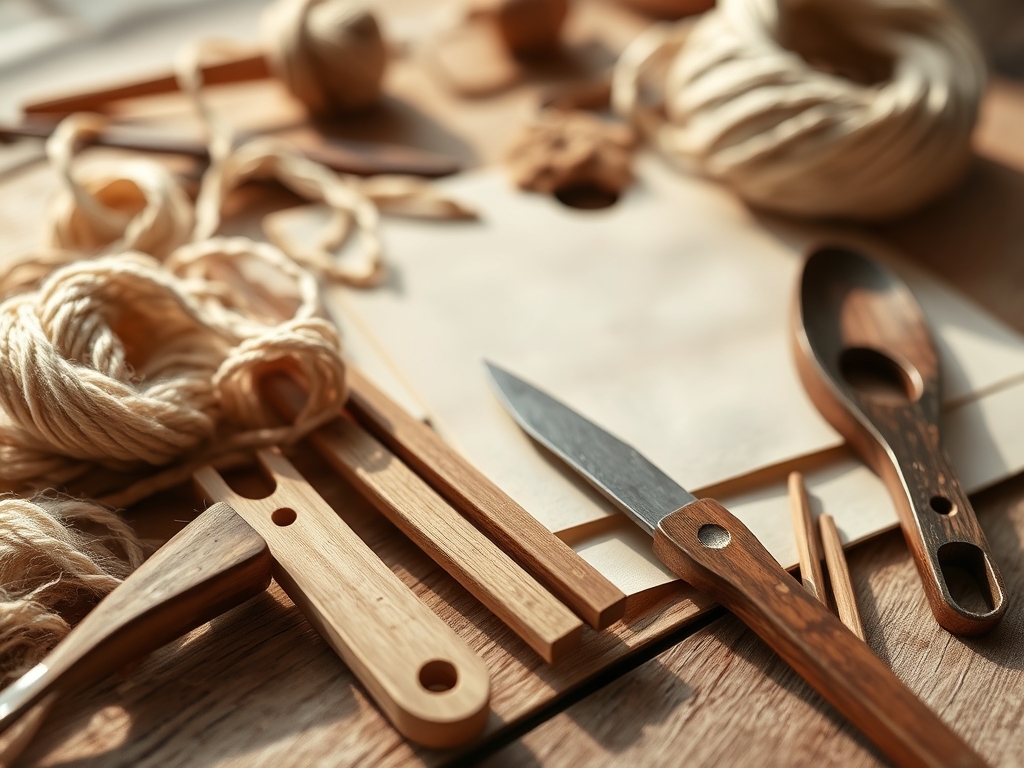
To master the maker mindset, you need tools that act as extensions of your own sensory nervous system. We start with precision calipers to measure the exact thickness of your materials down to the millimeter. You will also need a high-carbon steel awl for marking pilot holes without splitting the grain. For finishing, a teflon bone folder is essential for creating crisp, structural creases in heavy-gauge paper or leather without leaving a shiny residue.
The materials themselves require a deep understanding of tensile strength. For this project, we are using vegetable-tanned leather and kiln-dried hardwoods. If you cannot find walnut, a Material Substitution of cherry or maple works beautifully; just remember that maple has a higher Janka hardness rating and will require more torque from your drill. If you are working with textiles, swap linen for a heavy cotton duck, but account for the difference in porosity when applying dyes or sealants. Always keep a rotary cutter with a fresh tungsten carbide blade on standby to ensure your edges are shear-perfect rather than frayed.
THE TEMPO
The "Maker's Rhythm" is a biological metronome that prevents burnout and ensures technical accuracy. We break our sessions into three distinct phases. Phase one is the Tactile Assessment, lasting 30 minutes, where you inspect every inch of your raw material for defects or weak spots. Phase two is the Active Execution, usually a 3-hour block where the sympathetic nervous system is engaged. This is when the heavy lifting happens. Finally, phase three is the Reflective Burnish, a 45-minute cool-down where you clean your tools and document your progress.
Rushing through the curing or drying stages is a cardinal sin in the studio. You must respect the molecular bonding time of your adhesives. If the glue bottle says twenty-four hours, you give it twenty-four. Trying to manipulate a joint before the polymers have fully cross-linked will result in structural failure. Patience is a mechanical requirement, not just a virtue.
THE CORE METHOD
1. The Anchoring Breath
Before you touch a single tool, stand at your workbench and find your center of gravity. This sets the neurological tone for the entire build. A shaky hand leads to a jagged cut. By stabilizing your core, you provide a steady platform for your fine motor skills to operate.
Mastery Tip: This is about proprioception. When your body is aligned, your brain can more accurately calculate the force needed to drive a chisel or guide a needle, reducing the risk of accidental gouges.
2. Calibrating Your Perspective
Look at your raw materials and visualize the internal structure. If you are working with wood, identify the pith and the sapwood. If it is metal, consider the annealing state. You are not just looking at a surface; you are looking at a three-dimensional lattice of atoms.
Mastery Tip: Understanding grain direction is vital. Cutting against the grain causes "tear-out," where the fibers lift and shatter. Always cut in the direction that keeps the fibers compressed for a smoother finish.
3. The Precision Score
Use your marking knife to create a physical "trench" for your saw or blade to follow. A pencil line has width and can be imprecise; a scored line is a literal physical boundary that traps the edge of your tool.
Mastery Tip: This technique utilizes mechanical guidance. The blade of your saw will naturally seek the path of least resistance, which is the scored line you just created, ensuring sub-millimeter accuracy.
4. Embracing the Pivot
When a mistake happens, and it will, do not stop. Analyze the "error" through the lens of structural integrity. Can this gap be filled with a color-matched resin? Can this uneven edge be turned into a decorative chamfer?
Mastery Tip: This is the science of material recovery. Often, a mistake reveals a hidden stress point in the material that needed to be addressed anyway. Adapting your design mid-stream is a sign of high-level cognitive flexibility.
5. The Friction Check
As you assemble your pieces, pay attention to the "fit." A perfect joint should have a slight "whoosh" of air escaping as the pieces slide together. If you have to hammer it, it is too tight. If it wobbles, it is too loose.
Mastery Tip: This involves interference fit physics. You want just enough friction to hold the pieces together via surface tension and mechanical interlocking before the adhesive is even applied.
6. Controlled Saturation
When applying finishes, whether it is oil, wax, or paint, do it in thin, sequential layers. Flooding the surface can cause the material to swell or warp as it absorbs too much moisture too quickly.
Mastery Tip: This relies on capillary action. Thin layers allow the finish to penetrate deep into the pores without overwhelming the cellular structure of the material, leading to a more durable bond.
7. The Final Burnish
Use a smooth tool or a high-grit abrasive to "close" the surface of your project. This creates a barrier against environmental moisture and gives the piece a professional, tactile sheen.
Mastery Tip: Burnishing actually compresses the surface fibers, increasing the local density and making the material more resistant to scratches and impact damage over time.
8. The Documentation Loop
Take a photo of the finished piece and write down one thing you learned about the material's behavior. This turns a single project into a permanent addition to your internal database of maker knowledge.
Mastery Tip: This is metacognitive reinforcement. By articulating the technical challenge you overcame, you hardwire that solution into your long-term memory for future builds.
THE TECHNICAL LEDGER
To maintain a Nurturing Maker Mindset, your environment must support your tools. Maintenance and Longevity are non-negotiable. Wipe your steel tools with a light coat of camellia oil to prevent oxidation. Sharpen your blades after every ten hours of use; a dull tool is a dangerous tool because it requires excessive force to operate.
For Material Variations, consider using reclaimed "sinker" cypress for its rot resistance or recycled HDPE plastic for its incredible durability and vibrant colors. If you are going premium, source "quarter-sawn" lumber, which is more stable and less prone to cupping than "flat-sawn" boards.
The Correction: Common Pitfalls
- The Over-Sand: If you sand through a veneer, you cannot "fix" it. You must either re-veneer the entire surface or incorporate a decorative inlay to hide the substrate.
- The Glue Starve: Applying too much clamping pressure can squeeze all the glue out of a joint. Use a torque wrench or "hand-tight" pressure to ensure a thin film of adhesive remains.
- The Grain Clash: Joining two pieces of wood with perpendicular grain directions can cause the piece to crack as it expands and contracts with humidity. Use "floating" joinery like a breadboard end to allow for movement.
For Studio Organization, store your wood horizontally on a rack with "stickers" (small spacers) between boards to allow for even airflow. This prevents the wood from developing a "bow" or "twist" due to uneven moisture loss.
THE FINAL REVEAL
Look at that! You have transitioned from a pile of raw, unyielding materials to a finished piece of functional art. Can you feel the weight of it? That solidity is the result of your technical precision and your refusal to back down when the material pushed back. The surface is smooth, the joints are tight, and the finish has that deep, inner glow that only comes from proper layering. This is the physical manifestation of a Nurturing Maker Mindset. You didn't just "make" something; you engineered a solution and refined your own skills in the process. Your studio is now a place of high-level production and deep satisfaction.
STUDIO QUESTIONS
How do I prevent wood from splintering when I drill?
Place a "sacrificial" piece of scrap wood tightly behind your workpiece. This provides back-pressure and supports the wood fibers as the drill bit exits, ensuring a clean, burr-free hole on both sides of your project.
What is the best way to clean a gummed-up saw blade?
Use a specialized pitch and resin remover or a simple solution of laundry detergent and water. Removing the baked-on carbon and resin reduces friction and heat, which extends the life of the blade and improves cut quality.
Why does my glue joint keep failing?
Check the moisture content of your wood using a moisture meter. If the wood is too wet (above 12%), the water inside the cells will interfere with the adhesive's ability to create a strong polymer bond.
How can I tell if my chisel is truly sharp?
A truly sharp edge should be able to shave a thin curl of hair off your arm or slice through a piece of loose paper with zero resistance. If it tears the paper, you need to return to the honing stone.