Imagine the scent of iron gall ink and the crisp, tactile resistance of high-grammage paper under your fingertips. This is your Intro to Modern Calligraphy; a journey where physics meets art through the controlled release of fluid dynamics. You are not just writing; you are mastering the tensile strength of a metal nib to create visual poetry.
THE STUDIO KIT
To begin, you need an oblique pen holder or a straight holder with an ergonomic grip. The nib, typically a G-nib like the Nikko G, is a masterpiece of metallurgy. It features a slit that acts as a reservoir, utilizing capillary action to pull ink from the well to the paper. Your paper must be non-porous and at least 100gsm to prevent feathering, which occurs when the ink spreads uncontrollably through the paper fibers.
For the ink, a high-pigment carbon ink provides the necessary viscosity to cling to the nib. If you lack a professional kit, you can experiment with Material Substitutions. A firm-tip brush marker can mimic the pressure-sensitive flex of a nib, or you can use a high-quality fountain pen ink thickened with a touch of gum arabic to adjust the surface tension. Professional calligraphers often use a bone folder to pre-crease their guide sheets, ensuring the paper lies perfectly flat for consistent contact.
THE TEMPO
The "Maker's Rhythm" is a slow, meditative cadence. You cannot rush the drying time of heavy ink deposits. Expect to spend 15 minutes on your studio setup, including cleaning the manufacturing oils off your new nibs with a bit of toothpaste or a flame. The practice phase for the 8 basic strokes should take roughly 45 to 60 minutes per session. Modern calligraphy is about the interstitial space between strokes; the pause where you reset your grip and breathe is just as vital as the movement itself.
THE CORE METHOD
1. The Entrance Stroke
This is a thin, delicate upstroke. Start at the baseline and move upward with the lightest possible pressure. Because you are moving against the grain direction of the paper, any excess force will cause the nib to snag and splatter.
Mastery Tip: This stroke relies on the low friction of the nib's tip. Keep your hand light to ensure the ink flow remains a hairline.
2. The Downstroke
This is the "muscle" of your letter. Apply firm, even pressure as you pull the pen toward your waist. The nib tines will spread, increasing the aperture and allowing a wider ribbon of ink to flow onto the page.
Mastery Tip: Focus on structural integrity. If you apply pressure unevenly, one tine will dig deeper into the paper, causing an asymmetrical line.
3. The Overturn
Start at the baseline with a thin upstroke, curve gracefully at the header line, and transition into a thick downstroke. This requires a precise pressure shift at the apex of the curve.
Mastery Tip: The science here is fluid displacement. You must gradually increase pressure to avoid a "blob" at the transition point where gravity assists the ink flow.
4. The Underturn
The inverse of the overturn; start with a thick downstroke and transition into a thin upstroke at the baseline. This is the foundation for letters like 'u' and 'w'.
Mastery Tip: To achieve a clean transition, release pressure before you hit the baseline. This utilizes the elasticity of the metal nib to snap back to its closed position.
5. The Compound Curve
This is a "wave" stroke that combines the overturn and underturn. It tests your ability to maintain a consistent axis while toggling pressure.
Mastery Tip: Observe the symmetry. The point where the thickest part of the stroke transitions back to thin should be the exact midpoint of the curve to maintain visual balance.
6. The Oval
The most difficult stroke to master. Start at the "2 o'clock" position, move up and left with a thin line, swell into a thick downstroke on the left side, and close the loop with a thin upstroke.
Mastery Tip: The oval relies on centripetal force. Keep your elbow as the pivot point to ensure the curve is smooth rather than shaky.
7. The Ascending Loop
Used for letters like 'b', 'd', and 'h'. Start at the waistline, move up in a thin loop, and descend in a heavy, straight downstroke.
Mastery Tip: The loop must remain "open" to prevent the ink from bridging across the gap through surface tension, which would turn your loop into a solid blotch.
8. The Descending Loop
The foundation for 'g', 'j', and 'p'. Start with a thick downstroke that transitions into a thin, sweeping upward loop.
Mastery Tip: Ensure your alignment is consistent with your slant lines. The heavy downstroke provides the "anchor" for the letter's center of gravity.
THE TECHNICAL LEDGER
Maintenance & Longevity: Always dry your nibs immediately after use. Even a microscopic amount of moisture will lead to oxidation (rust), which ruins the nib's smooth glide. Use a soft lint-free cloth to burnish the metal.
Material Variations: For a sustainable approach, use recycled cotton rag paper, which has a beautiful tooth and high absorbency. Premium options include vellum, which offers a slicker surface for ultra-fine hairlines.
The Correction:
- Railroading: This happens when the ink doesn't bridge the gap between spread tines. Fix: Clean your nib or add a drop of water to your ink to decrease viscosity.
- Bleeding: Ink spreading into paper fibers. Fix: Use a paper with a higher sizing (a coating that resists liquid).
- Shaky Lines: Caused by finger-movement. Fix: Lock your wrist and move from the shoulder to utilize larger muscle groups.
Studio Organization: Store your nibs in a dry, airtight container with a small packet of silica gel. Keep your finished practice sheets flat in a portfolio to prevent hygroscopic warping from humidity changes.
THE FINAL REVEAL
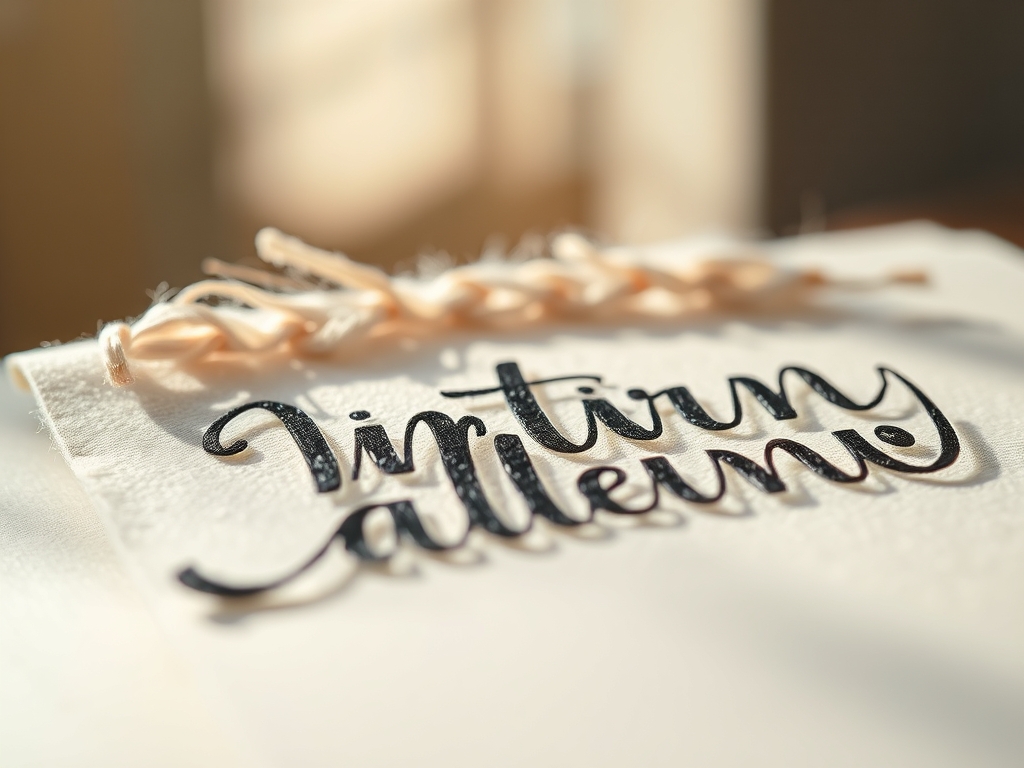
Look at that! You have successfully navigated the complex physics of the Intro to Modern Calligraphy. Your page is now a rhythmic display of contrast and geometry. Those thick swells and gossamer hairlines aren't just letters; they are a testament to your control over pressure and fluid flow. The way the ink sits slightly raised on the paper's surface gives the work a three-dimensional quality that digital fonts can never replicate. You are officially a maker of fine lines.
STUDIO QUESTIONS
What is the best ink for beginners?
Higgins Eternal or Sumi ink are ideal. They have the perfect viscosity to cling to the nib without being too thick, which prevents common flow issues and allows for smooth, consistent hairlines during your practice sessions.
Why is my nib scratching the paper?
This usually occurs because you are applying too much pressure on an upstroke or your nib angle is too steep. Ensure the nib is flush with the paper and use a light touch when moving upward.
Can I use regular printer paper?
Standard printer paper is too porous. The ink will soak into the fibers and "feather" outward. For the best results, use a smooth, coated paper like Rhodia or a high-quality 32lb laserjet paper.
How do I know when to change my nib?
Nibs are consumables. When the tip feels "scratchy" despite proper technique, or if the tines no longer snap back together due to metal fatigue, it is time to swap it for a fresh one.
How should I hold the pen?
Hold the pen at a 45-degree angle to the paper. Use a relaxed "tripod" grip. This ergonomic positioning allows the nib to flex properly without straining your hand during long studio sessions.